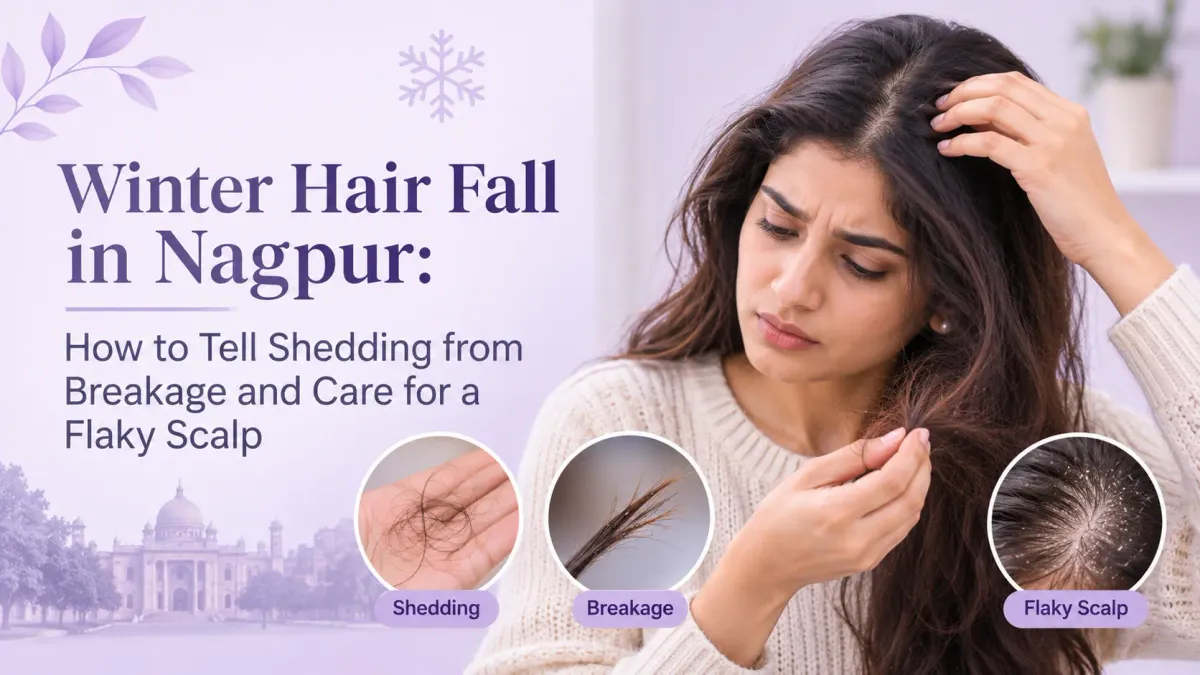
Winter Hair Fall in Nagpur: How to Tell Shedding from Breakage and Care for a Flaky Scalp
Winter hair fall is usually either breakage (short, snapped strands caused by dry air, friction, or heat) or shedding (full-length hairs released from the root, often triggered 2 to 3 months after illness or stress). Match your wash routine to your scalp's oiliness and itch, use lukewarm water, and see a dermatologist in Nagpur if you notice a widening part, bald patches, or persistent scaling. A few weeks into winter, you might find short strands on your comb and white flakes on the shoulders of a dark kurta. Both can catch your attention on the same morning, but they point to different questions. Is the hair snapping along its length? Are whole hairs shedding? Is your scalp dry, itchy, or scaly? What you notice can help you choose a gentler wash routine, decide whether a dandruff shampoo is worth trying, or recognise hair loss that deserves a closer look.

Dr. Nitin Barde
M.B.B.S, M.D, FRGUHS
Why am I noticing more hair on my comb in winter?
Quick answer: Look at the length of the strands. Hair breakage means short pieces of different lengths snapping along a dry or weakened shaft. Hair shedding means full-length hairs releasing from the follicle, often with a tiny white bulb at the root.
Timing alone tells you little about the cause, and losing roughly 50 to 100 hairs a day is part of a normal hair cycle. Think back to what has changed in your routine. In Nagpur's dry winter air, low humidity can strip moisture from the hair shaft. If you have also started blow-drying after every wash on cold mornings, rough ends that catch on the comb are a reason to turn the heat down and handle tangles gently. If you see more full-length hairs after stretching out the time between washes, several days of loose hairs may simply have come away together.
Persistent shedding has other possible explanations. An illness, childbirth, or major stress 2 to 3 months earlier (a pattern known as telogen effluvium) may matter more than the weather on the day you first notice it. A widening part or a new bare patch is worth assessing through a medical alopecia and hair loss evaluation, even if the amount of hair in the shower looks ordinary. Read Radiance Clinic's guide to hair fall causes and stages for more detail.
Is my flaky scalp dry, or could it be dandruff?
Quick answer: How your scalp feels between washes can tell you more than the colour of a single flake. Dryness, dandruff, and an irritated scalp can look similar.
| What you notice | What it may suggest | A sensible first step |
|---|---|---|
| Tightness after a hot wash, fine loose flakes, and dry skin elsewhere | Scalp dryness or irritation | Try lukewarm water and a gentle shampoo. |
| Itch and recurring flakes, sometimes with oily scale around the hairline or eyebrows | Dandruff or seborrhoeic dermatitis | Consider a dandruff shampoo and follow its label. |
| Burning after a new dye or fragranced product | A possible reaction to the product | Stop using it and seek advice if symptoms persist or worsen. |
| Thick scale, pain, or patches of broken hairs | A scalp condition that needs examination | Arrange a dermatology visit. |
If recurring itch and greasy flakes do not settle with over-the-counter shampoos, targeted seborrheic dermatitis treatment can help calm scalp inflammation. Thick, stubborn plaques or patchy hair breakage should also be checked to rule out conditions such as scalp psoriasis or a fungal scalp infection.
If your face, hands, and scalp all feel dry during Nagpur's cooler months, it can help to review the temperature and length of your showers as well as the products you use. See Radiance Clinic's winter skin guide for practical skin barrier care.
Elegance inYour Inbox
Join our curated circle and get 10% OFF on your first visit. Receive medical-grade insights, seasonal trends, and early access.
What should I change on wash day?
Quick answer: Choose shampoo according to how your scalp feels, then protect the lengths while conditioning, detangling, and drying.
- Wash with lukewarm water. Massage shampoo gently onto the scalp with your fingertips. Let the lather rinse through the lengths. Adjust the interval between washes to how quickly your scalp gets oily and what feels comfortable for your hair texture.
- Use dandruff shampoo as directed if flakes keep returning. Apply it to the scalp. Check the label for how long to leave it on and how often to use it, since products differ. If it causes burning or irritation, stop and seek advice.
- Condition the lengths. Give extra attention to ends that snag. Work through tangles gently from the tips upwards. For curls or coils, detangling while conditioner is in the hair can make this easier.
- Reduce friction and heat. Blot wet hair gently with a towel. On mornings when you need a dryer, choose a lower heat setting. If a tight bun or ponytail pulls at your temples, loosen it.
When should I see a dermatologist?
Quick answer: Book an assessment with a dermatologist in Nagpur if you develop a bald patch, a widening part, persistent shedding, or itching that continues despite appropriate scalp care. Seek prompt advice for a painful, swollen, or oozing scalp.
Bring the names of any shampoos, dyes, or treatments you recently started. If your part looks wider, an older photograph taken in similar light can help show what has changed. Tell the dermatologist when you first noticed the problem and whether the flakes, itch, or shedding came first.
Related care at Radiance Clinic Nagpur
A scalp examination can help distinguish breakage, shedding, and an inflammatory scalp condition. At your visit to Radiance Clinic in Nagpur, describe the change that bothers you most, whether that is itching between washes or a gradual loss of density. If an evaluation confirms ongoing follicle thinning rather than temporary seasonal breakage, medical therapies or regenerative options such as PRP therapy and GFC therapy may be discussed as part of a personalised plan.
Frequently asked questions
Can dandruff make my hair fall out?
Flakes alone cannot explain a change in hair density. Repeated scratching can damage hairs, and inflammation can accompany shedding. If itch improves but you still see thinning, mention both changes to your dermatologist.
Should I wash my hair less often in winter?
Start with how your scalp feels before and after washing. If it feels tight immediately afterwards, try cooler water and a milder shampoo. If it becomes oily and itchy between washes, stretching the interval further may leave you uncomfortable.
Should I oil my scalp if I have winter flakes?
Heavy oiling on a flaky scalp can worsen dandruff or seborrhoeic dermatitis by feeding yeast on the skin. If your scalp feels tight and dry without itch or oily scale, focus on lukewarm washes and a gentle shampoo first, and apply conditioner only to the hair lengths.
Do I need to count the hairs I lose each day?
A wash-day count is difficult to interpret because it depends partly on when you last washed or combed your hair. Changes you can describe consistently, such as a widening part, a bare patch, or shedding that continues across several washes, are more useful to bring to a consultation.