FSCT vs Hair Transplant: When Do You Need Surgery vs Stem Cells?
Choosing between Follicular Stem Cell Therapy (FSCT) and a hair transplant depends on your stage of hair loss. FSCT is a non-surgical, one-time treatment that uses your body's stem cells to stimulate existing follicles. A hair transplant is a surgical procedure that relocates healthy follicles to bald areas where regeneration is no longer possible.

Dr. Nitin Barde
M.B.B.S, M.D, FRGUHS
What Is Follicular Stem Cell Therapy (FSCT)?
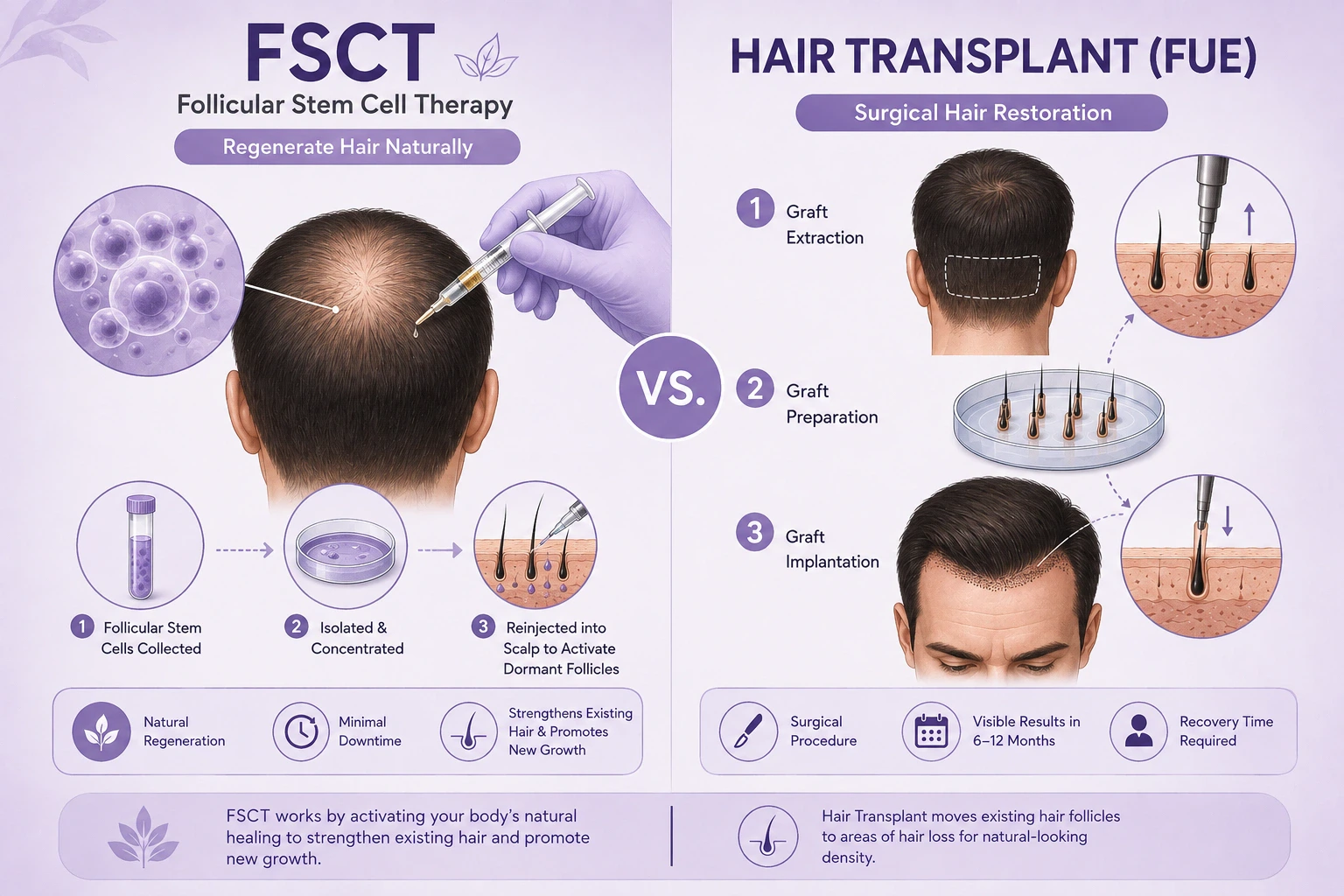
Follicular Stem Cell Therapy is an advanced, one-time regenerative treatment that extracts stem cells from your own healthy hair follicles to reactivate dormant or shrinking follicles in thinning areas. To learn more about this non-surgical approach, read our complete guide on fsct hair treatment at Radiance Clinic. Unlike traditional methods, fsct hair treatment tackles the biological root of hair thinning by providing the cellular building blocks necessary for robust hair growth.
In contrast, some people mistakenly search for a "follicular stem cell transplant." The correct medical procedure is a therapy and not a traditional transplant of whole grafts. This fsct treatment leverages the body's natural healing mechanism to reverse the miniaturization of hair, achieving measurable improvement in hair density within 3 to 6 months for most patients.
Why It Matters: Choosing the Right Intervention
Understanding the difference between fsct hair solutions and surgical restoration is critical because they serve entirely different stages of hair loss.
If you are experiencing early to moderate thinning, your follicles are likely still alive but dormant. Using fsct for hair growth in this phase can save you from invasive surgery. Many patients who seek treatment early are strong candidates for FSCT rather than surgery.
However, if an area is completely bald and the follicles have died, no amount of fst treatment for hair will bring them back, and this is where surgery becomes necessary.
"The biggest mistake patients make is waiting too long. FSCT works wonders when follicles are still viable. Once they are gone, a hair transplant is the only structural solution." - Dr. Nitin Barde, MBBS, MD (Dermatology)
Elegance inYour Inbox
Join our curated circle and get 10% OFF on your first visit. Receive medical-grade insights, seasonal trends, and early access.
How It Works: Surgery vs Stem Cells
When considering fsct in hair treatment versus surgery, the mechanisms of action differ significantly.
The FSCT Process (Step-by-Step)
The follicular stem cell therapy procedure follows a structured, single-session workflow:
1. Micro-biopsy extraction: A tiny tissue sample is taken from the back of the scalp, which is the donor-rich zone.
2. Stem cell isolation: The sample is processed in a specialized device to concentrate regenerative stem cells.
3. Targeted injection: The stem cell concentrate is injected into thinning areas to reactivate dormant follicles.
4. Natural regeneration: Over 3 to 6 months, the treated follicles transition from dormant to active growth phase.
Because it is a one-time treatment, you don't need continuous maintenance sessions unlike PRP, which typically requires multiple sessions per year.
The Hair Transplant Mechanism
A hair transplant (FUE or FUT) involves surgically extracting entire hair follicles from a donor zone and implanting them into bald regions. It is a structural relocation of hair, providing coverage where no hair exists. If you are considering surgical restoration, explore our advanced hair transplant options for a full breakdown of the techniques we offer.
As a result, transplants are best suited for patients with:
- Norwood Stage 3 or higher baldness
- Completely smooth bald patches (no visible pores)
- A stable donor area with sufficient graft availability
FSCT vs Hair Transplant: Which Treatment Is Right For You?
For example, if you are leaning towards regenerative medicine, fst hair treatment provides a seamless, natural solution. If you need structural density in bald patches, surgery is the path forward.
Cost Comparison: FSCT vs Hair Transplant in India
Understanding the financial commitment helps you plan better:
Exclusive Offer: Ready to restore your hair naturally? Book your fsct for hair session directly through our website and exclusive discount of upto ₹400! on price listed on third party platform Limited slots available this month.
Recovery Timeline: What to Expect
Common Mistakes When Seeking Hair Restoration
- Confusing Terminology: Many patients look for an fsct hair transplant or a follicular stem cell transplant. Remember that FSCT is a therapy to stimulate growth, while a transplant moves actual hair.
- Waiting Too Long: Delaying Fsct treatment for hair until follicles are dead reduces the effectiveness of regenerative therapies significantly.
- Booking via Third Parties: Booking surgical procedures through external platforms often comes with hidden fees and higher pricing.
- Skipping the Consultation: Every patient's hair loss pattern is unique. A proper scalp analysis by a qualified dermatologist determines whether FSCT, surgery, or a combination approach is needed.
Surgical Booking Bonus: If you need a hair transplant, book directly through our website to get up to ₹400 off compared to third-party platforms. Why pay more for the same treatment?
FAQs
What is the success rate of FSCT for hair growth?
FSCT improves hair density for patients with active dormant follicles. Visible results appear within 3 to 6 months as stem cells trigger natural regenerative cycles.
Is follicular stem cell therapy a one-time treatment?
Yes. Unlike PRP which requires multiple sessions, FSCT is a single-session treatment providing a long-lasting biological trigger for hair regeneration.
Can I combine an FSCT hair treatment with a transplant?
Yes. Many surgeons use FSCT alongside transplants to accelerate donor-area healing and boost the survival rate of newly transplanted grafts.
Does FST treatment for hair restoration hurt?
The procedure involves mild discomfort. A local anesthetic is applied to biopsy and injection sites, making it highly tolerable with virtually no downtime.
How do I know if I need FSCT treatment or surgery?
If you have thinning hair with visible scalp pores, FSCT is ideal. Completely bald patches with no visible pores require a surgical transplant.
Conclusion
Both fsct and hair transplants offer life-changing results for hair loss, but they are not interchangeable. Fsct hair solutions focus on saving and thickening what you have through regenerative science, making it the ultimate one-time preventative and restorative measure for early-stage thinning. Conversely, surgery is the gold standard for replacing what is completely lost.
Assess your hair loss stage, consult with a specialist, and choose the treatment that aligns with your biological needs. The sooner you act, the more options you have.
Ready to take the first step? Book a free consultation at Radiance Clinic to find out which treatment is right for you, and booking directly from the website give you upto 400 rupees off on price listed on third party platforms like practo or fresha.