PRP Hair Treatment: Real Results, Timeline & Side Effects Explained
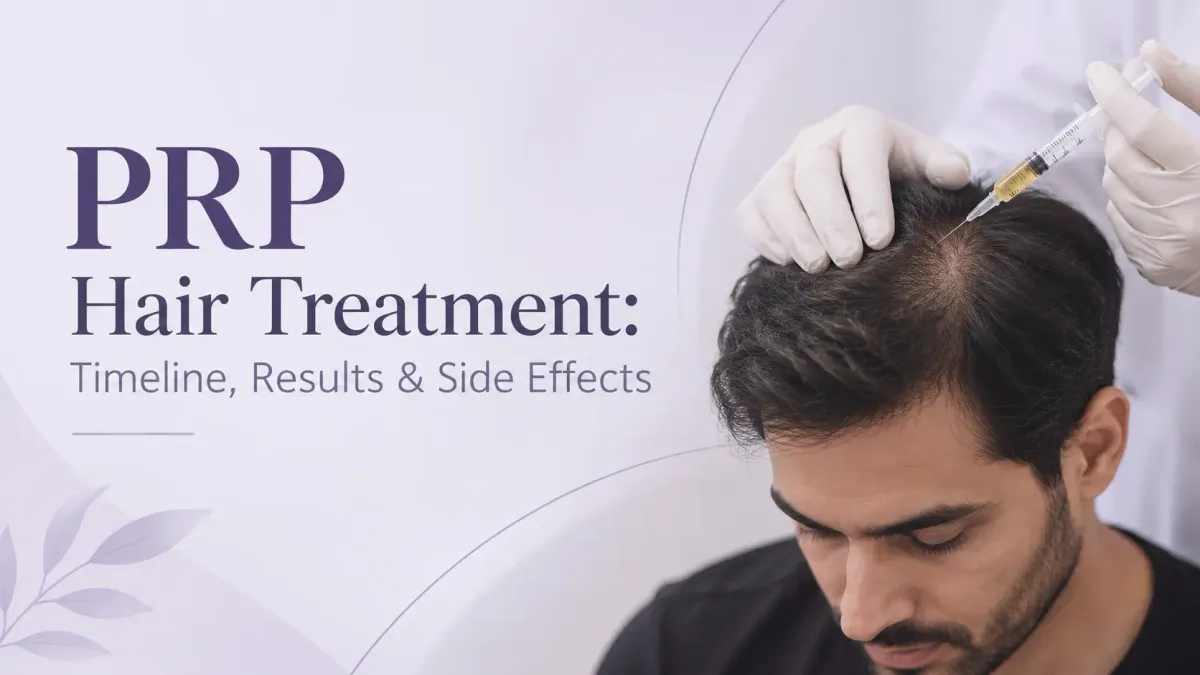
PRP (Platelet-Rich Plasma) therapy relies on growth factors taken from your own blood to wake up dormant hair follicles, lower shedding rates, and slowly thicken the hair you already have. The majority of people see their hair fall decrease within 4 to 6 weeks, notice visible new growth around month 3, and hit peak density by month 6. Side effects tend to be mild, mostly involving scalp redness and tenderness that fade within a day or two.

Dr. Nitin Barde
M.B.B.S, M.D, FRGUHS
What Is PRP Therapy for Hair Loss?
PRP (Platelet-Rich Plasma) therapy is a non-surgical hair restoration treatment where a patient's own blood is processed to isolate platelets and growth factors, which are then injected into the scalp to trigger hair follicle activity. Your blood naturally carries platelets, which are tiny cells loaded with proteins known as growth factors. When doctors concentrate these and inject them directly into your scalp, the growth factors tell dormant or weak follicles to shift back into their active growing phase (anagen). The procedure doesn't involve transplanting cells or adding outside chemicals. It relies entirely on your body's own materials.
Doctors use PRP as a standalone option for early to moderate hair loss. It is also frequently used as a follow-up therapy after hair transplant surgery to help grafts survive and speed up the healing process.
At Radiance Clinic, a dedicated skin and hair restoration centre in Nagpur, our PRP therapy starts with a trichoscopy (a close-up scalp analysis). This checks whether your follicles are still viable and helps us decide if PRP alone is the right move, or if we should pair it with something else like GFC Therapy or Exosome Hair Therapy.
The Realistic PRP Results Timeline
One of the most common questions people ask about PRP is when they will actually see results. The truth is that it varies based on how advanced your hair loss is, your individual platelet count, and whether you stick to the recommended session schedule. However, there is a standard clinical timeline most patients follow.
Month 1: Reduced Shedding (The Quiet Phase)
Most patients notice fewer hairs on their pillow and less hair clogging the shower drain within 4 to 6 weeks of their first appointment. This isn't new growth yet. It is the treatment halting the miniaturisation process in struggling follicles.
What you'll realistically see:
- A drop in daily hair fall (often going from 150-200 strands down to a normal 50-100)
- Your scalp might feel less itchy or more comfortable
- Zero visible change in hair density when looking in the mirror or taking photos
What you shouldn't expect: Don't look for new hair popping out of a bald spot. Right now, PRP is working beneath the surface at a cellular level.
Clinician note: If your shedding hasn't slowed down by week 6, mention it to your doctor at your next follow-up. It doesn't automatically mean the PRP isn't working, it just might mean your dosing schedule needs a tweak.
Month 3: First Visible Signs of New Growth
By the three-month mark (usually after 2 or 3 sessions if you're going monthly), the majority of patients start noticing fine, baby hairs popping up in areas that were thinning out.
What you'll realistically see:
- Fine vellus (baby) hairs that might look a bit lighter in texture at first
- The hair you already have might feel slightly stronger or thicker
- Photos taken in the exact same lighting will begin to show a slight difference
What success actually looks like at month 3: A photo taken at this point should show subtle improvements in hairline density and fewer see-through spots at the crown. It won't look anything like a hair transplant result yet. Comparison point: The results you get from PRP at month 3 are generally similar to what you'd see from minoxidil at month 5 or 6 in clinical trials, especially for pattern hair loss (androgenetic alopecia).
Month 6: Peak Improvement Window
Month 6 is typically the peak visible result you'll get from a standard round of PRP. By this time, people who respond well to the treatment will have finished 4 to 6 sessions (depending on whether they went monthly or bi-monthly).
What you'll realistically see:
- Hair in the treated zones looks noticeably denser
- Those early baby hairs have thickened up into normal terminal hairs
- The hairline looks fuller, especially around the temples for men and along the parting line for women
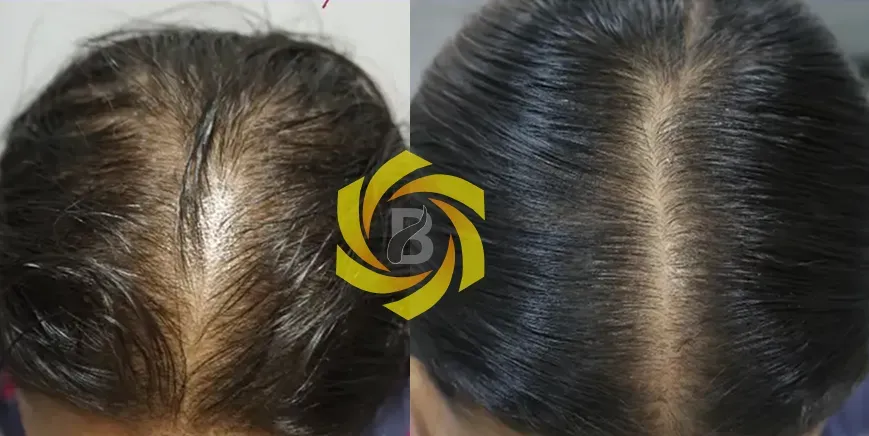
- Before-and-after photos will show a clear, undeniable difference
The ceiling of results: Keep in mind that PRP can't grow hair in spots where the follicles are completely dead (like in scarred alopecia or total baldness). It only works where follicles still exist but are currently dormant or miniaturised. Your doctor will check for this during your initial trichoscopy.
Elegance inYour Inbox
Join our curated circle and get 10% OFF on your first visit. Receive medical-grade insights, seasonal trends, and early access.
What "Success" Looks Like in Before/After Photos
Before you sign up for PRP because of a flashy before-and-after photo on social media, you need to know what real improvement looks like and how to spot misleading marketing.
Signs of Authentic PRP Results:
- Hairline density change. The area looks fuller but lacks the sharp, dense line you get from surgery.
- Better crown coverage. You see less scalp shining through when the hair is parted under a light.
- Consistent lighting. Clinics often use harsh downward lighting for the "before" shot and flattering angles for the "after." Look for photos with identical lighting.
- Timeline stated. Honest clinics will always tell you how many sessions it took and how much time passed between the two photos.
What Success Is NOT:
- A total fix for advanced (Grade VI-VII Norwood) baldness. PRP will not restore hair in completely bald areas.
- Identical results across all patients. How well it works depends on your platelet quality, the stage of your hair loss, and the root cause (hormonal, nutritional, or genetic).
- Permanent density without any follow-up. We explain this more in the FAQ section below.
At Radiance Clinic, our before-and-after gallery shows actual patient outcomes, clearly listing session counts and timeframes. We always take these photos under standardised clinic lighting.
Full Side Effects List: Normal vs. When to Worry
Because PRP uses your own blood, the chance of an allergic reaction is practically zero. The side effects that do happen are almost always mild and related to the injections themselves. Here is the full breakdown of what to expect:
Normal Side Effects (Expected, Self-Resolving)
| Side Effect | Onset | Duration | What It Means |
|---|---|---|---|
| Scalp redness | Right after | 4-24 hours | A normal inflammatory reaction to the needle |
| Tenderness or soreness | Right after | 24-48 hours | The scalp is sensitive from the injections, paracetamol helps |
| Mild scalp swelling | 0-6 hours | Up to 48 hours | Fluid response to the treatment, goes away on its own |
| Pinpoint bruising | 1-2 days | 3-5 days | Caused by the needle breaking tiny capillaries |
| Temporary tightness | 0-24 hours | 24 hours | Tension from the fluid injected into the scalp |
| Mild headache | 0-4 hours | A few hours | Tension from the procedure itself, drinking water helps |
What to do: You don't need to treat these side effects. Just skip washing your hair for 24 hours, avoid heavy workouts for 48 hours, and stay away from blood-thinners like aspirin or ibuprofen for 3 to 5 days, just like your doctor advises.
Side Effects That Need Monitoring
| Side Effect | What to Watch | Action |
|---|---|---|
| Swelling moving to the forehead or eyes | If it shows up 24+ hours later and keeps getting worse | Call your clinic |
| Soreness that lasts past 5 days | This is unusual, it should be gone by day 3 or 4 | Schedule a review |
| Small lumps under the scalp | Usually just the PRP fluid pooling, which goes away | Mention it at your follow-up |
| More scalp flaking or dryness | Some people get temporary dryness after the procedure | Use your prescribed scalp care kit |
Rare Complications (Seek Immediate Care)
These are extremely rare when PRP is prepared properly, but you should get medical attention if you notice:
- Signs of infection (heat, pus, fever, spreading redness). Very uncommon since it's your own blood, but possible if the clinic didn't follow strict scalp hygiene rules.
- Calcification at injection sites. This happens if the injections are done at the wrong depth, it is an issue with the injector's technique, not your body.
- No improvement after a full course. This isn't a complication, but it's a huge sign that your diagnosis needs a second look. Issues like thyroid problems, iron deficiency anaemia, or scarring alopecia might be causing the hair loss instead.
How Many Sessions Before You See Visible Change?
This is the number one question people ask. Here is the clinical consensus based on medical literature:
Standard Protocol at Most Evidence-Based Clinics:
| Stage | Sessions | Interval | Goal |
|---|---|---|---|
| Initial course | 3-4 sessions | Monthly (every 4 weeks) | Wake up follicles, reduce hair fall |
| Consolidation | 1-2 sessions | Every 2-3 months | Strengthen the results, mature the new hairs |
| Maintenance | 1-2 sessions per year | Every 6 months | Keep the density you've gained |
The honest answer: The vast majority of patients see measurable changes (meaning you can see it in photos) after 3 sessions. Some people notice it earlier (after session 2), while a smaller group needs the full 4 to 6 sessions before things become obvious. If you have very low platelet counts or advanced hair loss, your results might be less pronounced.
At Radiance Clinic, Dr. Nitin Barde, our Founder, who holds an MD in Dermatology and a Fellowship in Dermatosurgery, always performs a trichoscopy assessment before you start. This microscopic look at your scalp tells us if your follicles are viable and helps us set realistic expectations for your specific situation, rather than just pushing a generic package.
Dr. Radhika Barde, our Aesthetic Physician (MBBS, DDV, Fellowship in Aesthetic Dermatology), handles the scalp care and maintenance phase. She makes sure that once you finish your initial PRP course, you know exactly how to keep those results long-term.
PRP vs. Other Non-Surgical Hair Treatments
| Treatment | Mechanism | Sessions for Initial Results | Invasiveness | Downtime |
|---|---|---|---|---|
| PRP Therapy | Your own growth factors | 3-4 monthly | Minimally invasive (injections) | None |
| GFC Therapy | Concentrated growth factor serum | 3-4 monthly | Minimally invasive (injections) | None |
| Exosome Therapy | Stem cell-derived vesicles | 2-3 monthly | Minimally invasive | None |
| FSCT (Follicular Stem Cell Therapy) | Stem cell regeneration | Varies | Minimally invasive | Minimal |
| Minoxidil (topical) | Widens blood vessels, extends growth phase | 5-6 months | Non-invasive | None |
| Hair Transplant (FUE) | Moves follicles to new areas | Single procedure | Surgical | 7-14 days |
We often combine PRP with GFC Therapy or Exosome Therapy for people with moderate hair loss who want faster results without getting surgery. Which combination works best depends heavily on your trichoscopy results and your hair loss grade.
If you have advanced pattern baldness and your follicles are no longer viable, a hair transplant is still the best route, and we often use PRP afterwards to help the new grafts settle in.
Frequently Asked Questions
Q: Is PRP hair treatment permanent?
A: PRP results aren't permanent. The treatment slows down hair thinning and wakes up dormant follicles, but the main cause of your hair loss (usually genetics or hormones) is still there. Most people need a maintenance session every 6 to 12 months to keep their results.
Q: Does PRP really work for hair loss?
A: Yes, if you're the right candidate. Medical studies show that PRP significantly boosts hair density and cuts down on shedding for people dealing with pattern baldness and alopecia areata. It does its best work during early to moderate hair loss when follicles are dormant rather than dead.
Q: How many PRP sessions do you need for hair regrowth?
A: Standard clinical protocols suggest 3 to 4 monthly sessions to kick things off. You'll usually start seeing visible changes after the second or third session. Getting a consolidation session at 3 months and then returning every 6 months helps maintain the new growth.
Q: What should I avoid after a PRP hair treatment session?
A: Don't wash your hair for 24 hours, skip heavy workouts for 48 hours, stay away from blood-thinners (like aspirin and ibuprofen) for 3 to 5 days, and keep your scalp out of direct sunlight for the first day. Always follow the specific instructions your clinic gives you.
Q: Can PRP regrow hair on a completely bald scalp?
A: No. PRP can only stimulate follicles that are dormant or weak. It has no power to regenerate follicles that have died and disappeared. A proper microscopic scalp analysis (trichoscopy) will tell your doctor if you still have viable follicles before you start treatment.
Conclusion: Is PRP the Right Treatment for You?
PRP hair treatment remains one of the most researched, evidence-backed non-surgical solutions for hair loss on the market today. It absolutely works. But it only works within certain limits, and those limits depend on how far your hair loss has progressed, the technique of the doctor doing the injections, and whether anyone is addressing the root cause of your hair loss at the same time.
What PRP is great at: stopping early shedding, thickening the hair you have, boosting scalp health, and helping other treatments work better.
What it won't do: grow hair out of dead follicles, permanently cure genetic baldness, or give you the heavy density of a surgical hair transplant.
If you live in Nagpur and want a straight answer about whether PRP makes sense for your hair, the team at Radiance Clinic runs full trichoscopy assessments before suggesting any procedures. There is no pressure to buy packages, just a clear diagnosis so you know your options.