How to Stop Genetic Hair Loss: Can Hereditary Hair Fall Be Reversed?
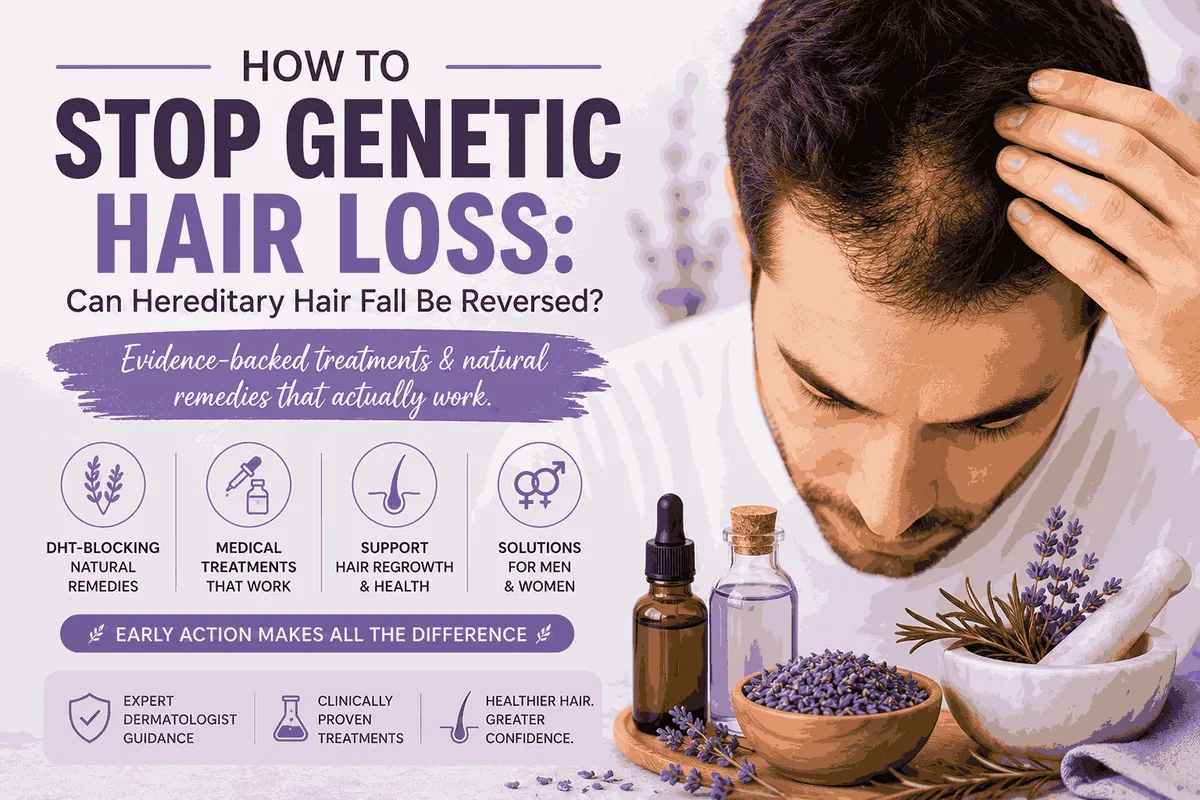
If you have watched a parent or grandparent lose their hair and started noticing changes in your own, a shifting hairline, a wider part, less volume where there used to be plenty, you are probably asking the question this article is built to answer: can you actually stop genetic hair loss, or is it inevitable? The honest answer is that androgenetic alopecia, the clinical name for hereditary hair loss, cannot be completely stopped if you carry the genes for it. But it can be significantly slowed, and in early stages, partially reversed. The most important factor in determining your outcome is not which product you buy, it is how early you act. This guide covers how genetic hair loss works, what natural approaches genuinely help, which medical treatments are evidence-backed, how it affects men and women differently, and when professional evaluation gives you the best chance of keeping the hair you have.

Dr. Nitin Barde
M.B.B.S, M.D, FRGUHS
What Is Genetic Hair Loss and How Do You Know If You Have It?
What Causes Hereditary Hair Loss?
Genetic hair loss, androgenetic alopecia is caused by a combination of inherited genetics and the effects of a hormone called DHT (dihydrotestosterone). DHT is a byproduct of testosterone, produced when the enzyme 5-alpha reductase converts testosterone into its more potent form.
In people with a genetic sensitivity to DHT, the hormone binds to receptors in hair follicles and causes them to shrink a process called miniaturisation. Over successive hair cycles, each strand grows back thinner and shorter until the follicle eventually stops producing visible hair. This is a gradual process that unfolds over years or decades.
The key point: DHT sensitivity is inherited. You do not need both parents to have it; the gene can come from either side of the family, and the pattern of inheritance is complex. If you have close relatives with significant hair thinning, your risk is meaningfully elevated.
Signs of Genetic Hair Loss
- Gradual thinning over months and years not sudden shedding (which typically suggests a different cause)
- Receding hairline starting at the temples in men (the classic 'M' shape)
- Widening part line in women the part looks broader than it used to
- Loss of density at the crown that becomes visible in overhead lighting
- Hair that feels finer and more fragile than it once did
- Family history of hair thinning on either parent's side
The absence of family history does not rule out androgenetic alopecia genetic expression is variable but its presence is a strong signal worth taking seriously.
Male vs Female Pattern Differences
In men, androgenetic alopecia follows a predictable pattern: the hairline recedes at the temples, the crown thins, and over time these two areas merge. The Hamilton-Norwood scale classifies seven stages of male pattern baldness from minimal recession to complete baldness on top.
In women, the pattern is different. Female pattern hair loss (FPHL) presents as diffuse thinning across the scalp particularly noticeable at the parting rather than a receding hairline. Women rarely go completely bald from FPHL, but the reduction in density and volume can be significant and emotionally distressing.
Elegance inYour Inbox
Join our curated circle and get 10% OFF on your first visit. Receive medical-grade insights, seasonal trends, and early access.
Genetic Hair Loss in Younger People: Can It Start in Your 20s or 30s?
How Do You Know If You Have It Early?
One of the most common and least discussed aspects of androgenetic alopecia is how early it can begin. Many people assume genetic hair loss is something that happens in your 40s or 50s. In reality, early onset androgenetic alopecia in the 20s and 30s is increasingly common, and it is often the people who dismiss early signs who experience the greatest long-term loss.
Early signs are subtle by design: a hairline that seems slightly higher than it was two years ago, a parting that looks slightly wider, hair that used to feel dense and now feels thinner when you run your fingers through it. These are not dramatic changes but they are meaningful, and they are worth paying attention to. If you are asking how to stop genetic hair loss at 25 or 30, the answer is: right now, before more follicles miniaturise.
Why Early Action Matters Most
The biology of androgenetic alopecia makes early intervention critical. Once a follicle has been fully miniaturised and stops producing hair, it becomes significantly harder and sometimes impossible to reactivate it. Hair follicles that are still partially functioning respond far better to both natural and medical treatments than follicles that have been dormant for years.
If you are in your 20s or 30s and noticing early signs of thinning with a family history of hair loss, this is the best possible time to act. Slowing the progression now preserves the follicles you have and gives any treatment the best chance of producing results.
How to Stop Hereditary Hair Loss Naturally (What Actually Helps)

Natural approaches cannot stop genetic hair loss completely but they can meaningfully slow DHT-driven follicle miniaturisation and support the overall scalp environment for healthier growth. The key is positioning them as a supportive strategy, not a cure.
DHT-Blocking Natural Remedies
Saw Palmetto: One of the best-studied natural DHT blockers. It inhibits 5-alpha reductase, the same enzyme targeted by pharmaceutical finasteride, reducing the conversion of testosterone to DHT. Available as capsules or in topical formulations. A 2012 study found palmetto increased hair density in men with mild to moderate androgenetic alopecia after 24 weeks.
Pumpkin Seed Oil: Contains phytosterols that inhibit 5-alpha reductase. A 2014 randomised controlled trial found significant improvement in hair count in men taking 400mg pumpkin seed oil daily for 24 weeks. Women-specific data is limited but the mechanism is consistent.
Green Tea Extract (EGCG): Epigallocatechin gallate, the active compound in green tea, has demonstrated DHT-inhibiting properties in laboratory studies and has been shown to stimulate hair follicle growth in isolated human hair follicle cultures. Available as a supplement or applied topically in some scalp formulations.
Scalp Stimulation
Rosemary Oil: A 2015 study in SKINmed Journal found rosemary oil produced comparable hair count improvement to 2% minoxidil after six months. Dilute 3-5 drops in a carrier oil and massage into the scalp 3-4 times a week. Leave for at least 30 minutes before washing.
Scalp Massage: Regular massage increases blood flow to follicles. A 2016 study found standardised scalp massage performed daily over 24 weeks produced measurable increases in hair thickness. Use your fingertips or a silicone massager in small circular motions for 5-10 minutes.
Lifestyle Improvements
- Stress reduction: Elevated cortisol pushes follicles into the resting phase and can accelerate DHT-driven loss. Exercise, sleep, and stress management practices directly support hair health.
- Sleep optimisation: Tissue repair including follicle repair happens during sleep. Chronic sleep deprivation elevates cortisol and suppresses hair-supportive hormones.
- Avoid tight hairstyles and heat damage: Traction alopecia from tight styles can compound genetic thinning at the hairline.
For a complete natural hair care routine: How to Stop Hair Loss and Regrow Hair Naturally
Diet and Nutrients That Support Genetic Hair Loss Management

Key Nutrients for Follicle Health
Zinc: Inhibits 5-alpha reductase activity, reducing DHT production, and plays a role in protein synthesis and follicle repair. Sources include pumpkin seeds, chickpeas, lentils, and cashews. Zinc deficiency is associated with accelerated hair thinning.
Biotin: Supports keratin synthesis, the structural protein hair is made of. While biotin deficiency is rare, ensuring adequate intake supports the quality and strength of new hair growth. Found in eggs, nuts, seeds, and sweet potatoes.
Vitamin D: Hair follicles have Vitamin D receptors, and low levels are associated with follicle dysfunction and miniaturisation. Deficiency is common, especially in people with limited sun exposure. Test before supplementing; a daily dose of 1,000-2,000 IU is commonly recommended.
Protein: Hair is keratin, a protein. Without adequate daily protein intake, follicles do not have the building material they need. Aim for 1.2-1.6g per kilogram of body weight from eggs, fish, paneer, lentils, and tofu.
Hidden Contributor: Iron Deficiency
Even in cases of confirmed genetic hair loss, iron deficiency, specifically low ferritin can significantly worsen shedding and reduce the effectiveness of any treatment. Women are especially at risk due to menstrual blood loss. If your hair loss feels heavier than expected for genetic thinning, check ferritin levels specifically (not just haemoglobin). Dermatologists recommend ferritin above 70 ng/mL for healthy hair growth.
Check iron recovery timelines: How Long Do Iron Tablets Take to Stop Hair Loss?
Medical Treatments That Actually Slow Genetic Hair Loss

FDA-Approved Treatments
Minoxidil (Topical): The most widely used and evidence-backed treatment for both male and female pattern hair loss. Applied directly to the scalp, it prolongs the anagen (growth) phase, increases blood flow to follicles, and stimulates follicle activity. Available in 2% and 5% formulations. Results typically appear at 3-6 months. Important: discontinuing minoxidil reverses gains within 3-6 months it requires ongoing use. Minoxidil is one of the most accessible first-line options for people asking how to stop genetic hair loss at home.
Finasteride (Oral): A prescription 5-alpha reductase inhibitor that blocks the conversion of testosterone to DHT systemically. Highly effective in men, clinical studies show it reduces hair loss progression in over 80% of men and produces visible regrowth in approximately 66% over two years. Generally not prescribed for women of childbearing age due to the risk of fetal harm during pregnancy.
Advanced Dermatological Treatments
PRP Therapy (Platelet-Rich Plasma): A dermatologist draws a small amount of your blood, concentrates the growth factor-rich plasma, and injects it into areas of thinning. PRP stimulates follicle activity and has shown consistent results in clinical trials for androgenetic alopecia, particularly in early-to-moderate stages.
GFC (Growth Factor Concentrate): A more concentrated version of PRP using only growth factors without the red blood cell component. May produce a more targeted stimulus for follicle regeneration with reduced inflammation.
Follicular Stem Cell Therapy (FSCT) : A newer approach that uses stem cells to reactivate dormant follicles and promote new hair growth. Particularly suited for patients who have not responded adequately to conventional treatments.
Microneedling (Dermaroller): Creates controlled micro-injuries on the scalp that stimulate growth factors and improve topical absorption. Often used in combination with minoxidil to enhance its penetration and effectiveness.
For people who do not respond well to home remedies, clinically supervised treatments like PRP, GFC, or FSCT can significantly improve hair density when started early. At Radiance Clinic, our dermatologists build personalised hair restoration plans based on scalp analysis, blood work, and the stage of hair loss so treatment targets your specific situation rather than a generic protocol. Learn About Hair Treatments at Radiance Clinic
Does Genetic Hair Loss Affect Women Differently Than Men?
What Is Female Pattern Hair Loss (FPHL)?
Female pattern hair loss is a common but chronically underdiagnosed form of androgenetic alopecia in women. Unlike its male counterpart, it does not receive the same cultural attention or widespread conversation, which means many women spend years attributing their thinning to stress, hormones, or diet when the root cause is genetic DHT sensitivity.
FPHL presents as diffuse thinning across the scalp most visible at the crown and along the parting rather than a receding hairline. Women typically retain their frontal hairline but notice a widening part, reduced volume when hair is tied back, and more scalp visible in photographs. The Ludwig scale classifies FPHL into three grades based on the extent of central thinning.
Why Treatment Differs for Women
Finasteride, the standard oral DHT blocker for men, is generally not prescribed for women of childbearing age due to the risk of birth defects if taken during pregnancy. Women with FPHL are typically offered:
- Minoxidil (topical, 2% or 5%): The first-line treatment for FPHL FDA-approved and clinically proven
- Spironolactone: An anti-androgen that reduces androgen activity and is particularly useful when hormonal factors overlap with genetic thinning
- Nutritional and hormonal assessment: Low iron, thyroid dysfunction, and PCOS can all worsen FPHL and should be investigated and addressed alongside any topical treatment
The Emotional Impact of Hair Loss in Women
Unlike male pattern baldness which has broad cultural visibility and acceptance, hair thinning in women is often silent. Women with FPHL frequently describe the experience as isolating: they feel their concerns are dismissed, minimised, or attributed to stress rather than taken seriously as a medical issue.
Hair is deeply linked to identity, confidence, and self-presentation for many women. The psychological impact of FPHL including anxiety, social withdrawal, and reduced confidence is well-documented and just as valid as any physical symptom. Seeking professional evaluation is not vanity; it is appropriate, early healthcare.
"Unlike male pattern baldness, which is widely discussed, hair thinning in women is often silent but just as real and treatable."
When Women Should Act Early
The gradual nature of FPHL makes it easy to dismiss until significant density has already been lost. If you are noticing a widening part, reduced volume, or hair that feels finer than it used to, this is the time to act, not when it becomes more obvious.
If linked to thyroid issues: Read: How to Stop Thyroid Hair Loss
If hormone-driven (PCOS): Read: How to Stop PCOS Hair Loss
If postpartum-related:Read: Postpartum Hair Loss Guide
Can You Reverse Genetic Hair Loss or Only Slow It Down?
Reality Check
This is the question people most want answered when they search for how to stop genetic hair loss and it deserves an honest response rather than false hope or unnecessary pessimism.
Natural methods: Slow progression. Reduce DHT activity at the scalp. Support follicle health. They will not regrow hair that has been lost from fully miniaturised follicles, but they can meaningfully delay further loss when started early. You can check our guide on How to stop hair loss naturally for broader view
Medical treatments (minoxidil, finasteride, PRP): Can produce genuine regrowth in early-to-moderate stages where follicles are still partially active. Results are most significant in the first two years of treatment. The earlier the treatment begins, the more hair there is to preserve and recover.
Advanced stages: Once follicles are fully dormant and the scalp shows visible bare skin, reversal is substantially harder. At this stage, hair transplant surgery becomes the most realistic option for coverage restoration.
Realistic Timeline Expectations
Months 1-3: Reduced shedding. The progression of miniaturisation begins to slow. Visible regrowth has not yet appeared.
Months 3-6: Stabilisation. Hair that was thinning stops progressing as rapidly. In some cases, early baby hair regrowth becomes visible.
Months 6-12: Visible improvement in density for those who started treatment early. Hair that grows back is typically thicker and stronger than it would have been without intervention.
Consistency is non-negotiable. Stopping treatment whether minoxidil, supplements, or PRP typically results in resumed progression within 3-6 months.
If you are noticing progressive thinning despite home care, getting an expert evaluation early can prevent further loss. The window where treatment produces the best outcomes is real and it closes gradually as follicles miniaturise further.
When Should You See a Hair Specialist?
Warning Signs That Need Professional Attention
- Rapid, accelerating thinning, not the gradual progression typical of androgenetic alopecia
- Visible scalp at the crown or temples that is progressing noticeably month over month
- No improvement or stabilisation after 3-6 months of consistent home care
- Hair loss accompanied by fatigue, weight changes, or other symptoms that suggest a systemic cause
- Patchy hair loss, this suggests a different diagnosis (alopecia areata) requiring different treatment
A professional scalp diagnosis can identify whether your hair loss is purely genetic or combined with contributing factors like thyroid imbalance, iron deficiency, or PCOS all of which can worsen genetic thinning and require their own treatment. At Radiance Clinic, Dr. Nitin Barde uses diagnostic tools including trichoscopy and targeted blood panels to map the exact cause of hair loss before recommending any treatment plan. Book a Consultation at Radiance Clinic
When DHT-Blocking Treatments Are Not Enough: Follicular Stem Cell Therapy (FSCT)
If you have been consistent with minoxidil, saw palmetto, or PRP and your hair is still progressively thinning, the follicles themselves may need more direct intervention.
Follicular Stem Cell Therapy (FSCT) is an advanced, non-surgical hair restoration treatment that uses stem cells derived from your own hair follicles to reactivate dormant follicles, stimulate new growth, and slow the miniaturisation process that drives androgenetic alopecia. It is particularly suited for patients who have not responded adequately to conventional DHT-blocking treatments.
Why FSCT is different from PRP or minoxidil:
- Minoxidil prolongs the growth phase but does not address follicle-level miniaturisation
- PRP uses growth factors to stimulate follicle activity
FSCT directly targets and reactivates follicles that have become dormant making it uniquely effective for genetic hair loss that has plateaued with other treatments
Who is FSCT best suited for in genetic hair loss?
- Men and women with androgenetic alopecia in early-to-moderate stages where follicles are still partially active
- Those with visible thinning at the crown, temples, or parting who have not achieved adequate results with minoxidil or PRP
- Anyone wanting to preserve follicles before they become permanently dormant because early intervention always produces better outcomes
FSCT is available at Radiance Skin Antiaging and Hair Transplant Clinic under the guidance of Dr. Nitin Barde. A consultation includes a detailed scalp assessment and blood work to confirm whether you are a suitable candidate before any treatment is recommended.
Learn More OR Book Appointment
Frequently Asked Questions About Genetic Hair Loss
Q: Can genetic hair loss be stopped completely?
A: Not completely, if you carry the gene for androgenetic alopecia, DHT sensitivity is part of your biology. However, with the right combination of DHT-blocking treatments (natural and medical), scalp care, and nutrient support, progression can be significantly slowed and, in early stages, partially reversed. The earlier you start, the better the outcome.
Q: Is genetic hair loss only inherited from the father's side?
A: No, this is a common myth. Androgenetic alopecia can be inherited from either parent. The gene responsible (AR gene) is carried on the X chromosome, which men inherit from their mothers, which is why maternal grandfather baldness is often cited as a predictor. But the inheritance pattern involves multiple genes, and family history on both sides is relevant.
Q: Can genetic hair loss start at 20?
A: Yes. Early onset androgenetic alopecia in the 20s is more common than most people realise, particularly in men. Noticing a gradually shifting hairline or reduced density at 20-25 with a family history of hair loss is a clear signal worth taking seriously. Early action produces significantly better outcomes than waiting until loss is advanced.
Q: Does minoxidil work for genetic hair loss?
A: Yes. minoxidil is FDA-approved for androgenetic alopecia in both men and women. It works by prolonging the growth phase of hair follicles and stimulating blood flow to the scalp. It does not block DHT, so it is often most effective when combined with a DHT-blocking treatment. Consistent daily use is required, stopping treatment reverses gains.
Q: What is the best natural treatment for hereditary hair loss?
A: The most evidence-supported natural approaches to stop hereditary hair loss are saw palmetto (DHT blocker), pumpkin seed oil (5-alpha reductase inhibitor), rosemary oil (comparable to 2% minoxidil in a 2015 study), and regular scalp massage. Combined with a zinc-rich, protein-adequate diet and addressing any iron deficiency, these form a solid natural support strategy though they are most effective in early-stage loss.
Q: Is hair loss from genetics permanent?
A: The follicle miniaturisation process is progressive, but follicles are not immediately and permanently destroyed. In early-to-moderate stages, follicles are partially active and can respond to treatment. Completely dormant follicles usually after years of untreated advanced loss are much harder to reactivate. Acting early significantly improves the prospects of maintaining hair density.
Final Takeaway: Managing Genetic Hair Loss the Smart Way
Genetic hair loss is not a verdict, it is a condition you can actively manage. The science is clear: starting early, combining natural DHT-blocking support with evidence-backed medical treatment, and addressing any nutritional or hormonal overlaps gives you the best possible outcome.
Be realistic about what each approach can achieve. Natural remedies slow progression and support follicle health; they are not a substitute for medical treatment in moderate-to-significant cases. Medical treatments like minoxidil and PRP can produce genuine density improvement but they require consistency and time.
Most importantly: do not wait for hair loss to become obvious before acting. The follicles you preserve now are significantly easier to maintain than follicles you try to reactivate later.
If you are navigating genetic hair loss at any stage a proper scalp and blood assessment at Radiance Clinic can map the exact drivers of your hair loss and build a treatment plan around your specific biology. Led by Dr. Nitin Barde, our team combines trichoscopy, diagnostic blood panels, and personalized treatment planning to give your hair the best possible chance. Learn About Our Hair Treatments
Not Sure What’s Causing Your Hair Loss?
The earlier you identify the cause, the easier it is to treat.
Get a personalized diagnosis and expert guidance tailored to your condition.
Book a consultation with Radiance Clinic to get 10% of with promocode HAIRLOSS10